Feed on
Posts
Comments


Banana - Andy Warhol - 1966

While reflecting on the work and life of Andy Warhol, who was born 80 years ago today, I got to thinking about Pop Art in general.

My first exposure to Pop Art was just before I turned 6 years old in 1964. My father was given a “gag gift” for his birthday of a plastic banana taped to piece of cardboard which had been framed. I remember he opened the gift and looked at it with a puzzled look on his face until the gift-giver told him it was a work of “pop art” and surely would be worth a fortune someday. The adults at the party all broke into laughter.

The “art” was promptly hung on the den wall where it stayed for a few years.

I loved that piece. I was as intrigued as a six year old could be as to what “pop art” was and what a banana on a piece of cardboard had to do with it. I even made a few of my own, browbeating my mother into buying me some plastic fruit at the old Bazaar Department Store in Huntington so could I make some similar works with plastic apples and even one with grapes.

While that being Pop Art (or even art) or not may be arguable. But what I was creating was certainly art to me at the time and I have never forgotten it.

It was a good number of years later before I ever heard of anyone named Andy Warhol. In fact, he painted his first banana in 1966. I am not sure my father and his friend had even heard of Warhol yet when the plastic banana art was created. I do remember being completely exstatic seeing my first Warhol banana. It immediately took me back to that old plastic banana taped to the cardboard from years before.

I guess it was Pop Art.

Anyway, that is where thinking about Andy Warhol’s birthday took me today. I wish Andy were still around - I’d send him a plastic banana.


Screenshot of thepurplemoon.com’s brand-spanking new website

After a few months of planning, being interrupted by little things like moving the whole damn shop, hundreds of  photographs and more than a little procrastination the new website for The Purple Moon is up and running as of today!

There are still some functions I hope to add and this still has only a portion of our inventory. All in all though it certainly is a better representation of our shop as it is now and I’m much happier with the design. The is more to come but the biggest part of the work is now behind me and the website is now live!

Stop by and take a peek.


Museum White Cup & Saucer Pair - Castleton China for Museum of Modern Art - Designer: Eva Zeisel - 1943

Described by New York Magazine as “…delicate and voluptuous, tableware where the tactile verges on the erotic.”

Pretty heady words for dishes - but then these are more than mere dishes. Designed by the legendary Eva Zeisel for the Museum of Modern Art in 1943 and produced by Castleton China the Museum White line is art and function combined. 

I was lucky enough to obtain a set of six cups and saucers recently and let me tell you they are a joy to look at and to use.

Zeisel, by the way, will celebrate her 102nd birthday on November 13th.


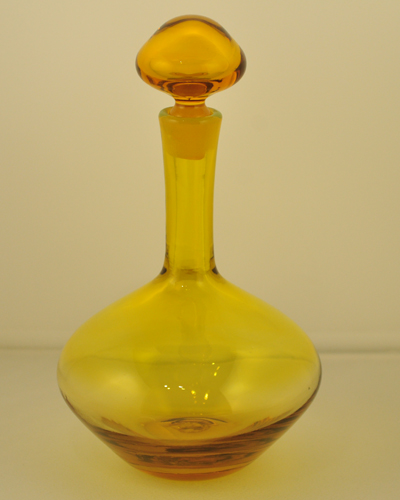
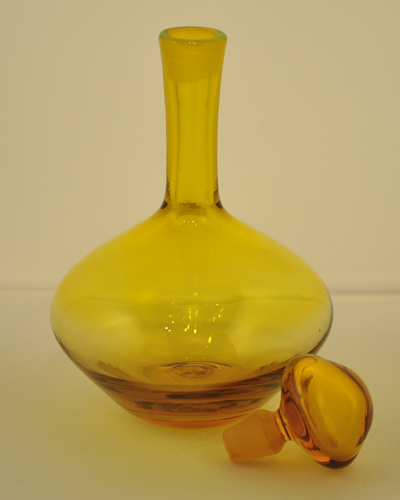
#475 Decanter - Blenko Glass - 1947

Before Winslow Anderson, Wayne Husted and Joel Myers were designing the glorious pieces during Blenko Glass’ ”golden years” of the 1950’s and 60’s there was the time that has come to be known to some collectors as the “pre-designer” period. While really not true, as these pieces had to be designed by someone, it was prior to the hiring of a full-time industrial designer by the firm.

During this time most pieces were designed primarily by Richard Blenko Sr. along with his team of craftsmen. The sales department also played a role in developing items they believed would do well in the marketplace. Certainly the work coming out of the company prior to 1948 did not lack in style, imagination or beauty as can be seen in examples like the #475 decanter shown above.


#445HB Tumbler Set - Blenko Glass - 1944

With the hiring of Winslow Anderson and the appearance of his first designs in the 1948 catalog Blenko Glass certainly saw a change in direction towards a more Scandanavian look. However it was more of an evolution than a revolution as the strength of Blenko design was there even before the first “designer” arrived. Luckily, that evolution continues through today.

Danish Teak Bookcase


Teak Bookcase - Made in Denmark - circa 1964

The beautiful, glowing teak bookcase from Denmark was one of my early Saturday morning finds in the wilds of West Virginia this week. In nearly pristine condition this great piece looked even better after a good rub down with some teak oil.

I just never know what I’m going to run into while out on “the hunt” but finding gems like this certainly motivates me to go at it again next week!


ModernMates Chests & Bedside Tables - Conant Ball - Designed by Russel Wright - 1949

I just found this week this wonderful set from Conant Ball’s ModernMates line designed by Russel Wright. With its modern component design in brushed birch this furniture was the follow-up to Wright’s American Modern for Conant Ball which began production in 1935.

As with so much of what we find the modern lady and I have the debate of if it goes to the showroom or home. This one is in the shop for now.


Catch-It-All Detail with Better Homes & Gardens - Designer: Sol Bloom

Useful, eye-catching, sleek, graceful and oh so modern the “Catch-It-All” designed by Sol Bloom and produced by Designs for Moderns in California for a very short period beginning in 1952 epitomizes mid-century modern design for the home. This seemingly simple object is sculptural in its design and extremely functional while retaining its minimalist qualities. A true masterpiece.

Not many of these classic pieces have survived the years and they were not made for long. Records are scarce but it appears as though by 1954 or so production ceased. Many were used outdoors and lost to the elements and still others discarded over the years by owners who did not recognize the rarity, value or design significance of these “magazine holders” as many called them.


Catch-It-All - Design for Moderns - Circa 1952 - Designer: Sol Bloom

I was fortunate enough to come upon this one on trip through Pennsylvania and Virginia not too long ago. In excellent condition with no breaks to the fine metal mesh this 20th Century treasure is one of those finds which keep people like me hunting for more.

The work of Canadian glass artist David Williamson will be on display at the West Virginia Museum of American Glass in Weston beginning August 7th and will open with an artist reception and Q&A from 7 to 9 p.m.

For those unfamiliar with the WVMAG it is one of West Virginia’s true treasures and just this year moved to a bigger and better home. The museum is located at 230 Main Avenue in Weston and is open 12 - 4  p.m. most days- however they are closed on Wednesday and Sunday.

The David Williamson exhibition, Threshold Awareness, will run through December 5th.


Three Piece Sectional Sofa in Salmon - Kroehler - circa 1955

Nothing says 50’s modern like one of these classic sectional sofas! This one, by Kroehler Manufacturing Company, is a real beauty and is one of our recent acquisitions.

Kroehler came into being in 1902 when Peter E. Kroehler bought the Naperville Lounge Co., a maker of wooden lounge chairs and upholstered furniture. Kroehler built a new factory in in 1913 after the original facility was destroyed by a tornado and renamed the company Kroehler Manufacturing Co. By the 1940s, Kroehler was the second-largest furniture maker in the United States. 

Their upholstered furniture pieces were likely in your grandma or great aunt’s home. I remember my Aunt Nell had a huge Kroehler sofa (covered in plastic, of course) in the early 1960’s. The plastic was always said to come off “If company came” but I never recall there being company of high enough stature to warrant such treatment.

Like many domestic furniture makers Kroehler struggled during the 1970s ultimately closing its Naperville factory in 1978. In 1981 Kroehler was acquired by the ATR Group of Northbrook. Today, furniture is still manufactured under the Kroehler name by two unrelated companies, one in North Carolina and the other in Ontario, Canada.

But nothing beats one of these mid-century marvels - which look as though Frank, Sammy, Dean and the boys should be surrounding it sipping cocktails.


Looking Outside to the Carbon Man Statue - Jean St. Thomas - 1941

A few of my earliest posts on this blog were about the United Carbon Building (now called Boulevard Towers) on Kanawha Boulevard in Charleston, WV and the sculptures by Robert E. Martens which grace that building. If you missed those at the time you can check them out here and here.

I’ve always loved this building - it is one of the finest examples of the modernist architectural style in West Virgina and is the only structure in the state which Eliel Saarinen played a role in designing. In addition to his collaboration with Charleston architect Walter Martens in designing the building his wife, Loja of the Cranbrook Academy, played a large role in designing the interiors for the United Carbon Building.

I have always wanted to take a trip back in time to see the inside of this building in all of its splendor and have finally been able to do the next best thing. Just this weekend I purchased three original photographs through another collector taken by renowned architectural photographer Jean St. Thomas just as the building was opening in 1941.

St. Thomas was well-known for her skills at capturing the subtle elements of art deco and modern design and her book, Marvelous New York: A Metropolis Portrayed(Davis McKay Co. 1937) is considered a classic of early 20th Century architectural images.

Discovering these photos made my weekend and gave me deeper appreciation for the deep modernist roots of this fabulous building.


Interior of United Carbon Building - Jean St. Thomas - 1941


Interior of United Carbon Building - Jean St. Thomas - 1941

Next »